An ND filter is a glass piece you put in front of a lens. It cuts light that hits the sensor. The colors and contrast stay the same. Filmmakers use it to keep a blurry background or slow shots in bright light. It lets them open the lens wide while keeping the shot dark enough.
Category
Camera accessory
Used for
Exposure control in bright light
Common confusion
Polarizing filters, which reduce glare but do not uniformly cut light
Also called
Neutral Density filter, ND glass
Often discussed with
Filming Equipment rental
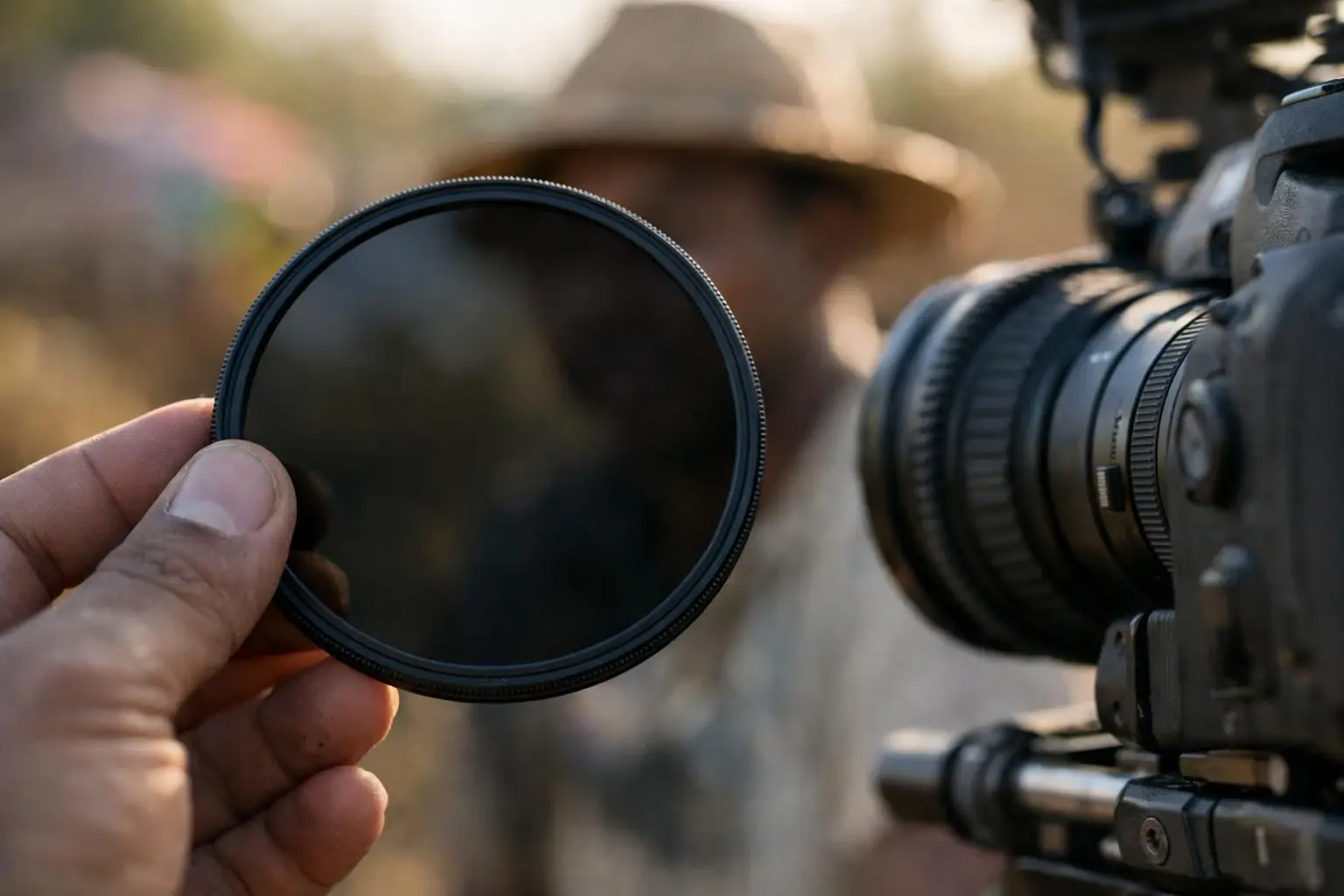
ND filter, short for Neutral Density filter, is a transparent glass or resin disc that mounts onto the front of a camera lens. Unlike colored filters that alter the hue of an image, ND filters are designed to be neutral, meaning they reduce light intensity evenly across all wavelengths. This neutrality ensures that the colors captured by the camera remain true to life. While the brightness of the scene is uniformly diminished. Filmmakers and photographers rely on ND filters to overcome limitations imposed by bright lighting conditions, particularly when shooting outdoors under direct sunlight.
Related glossary terms: Depth of field, ISO film speed, Camera stabilizer.
Without an ND filter, a camera’s sensor can become overexposed in bright light, forcing the operator to close the aperture or increase the shutter speed. Closing the aperture limits the creative control over depth of field, making it difficult to achieve a soft, blurred background. Increasing the shutter speed can result in unnatural motion blur, especially in video where a slower shutter speed is often preferred for smoother motion. ND filters solve this problem by allowing the camera to maintain optimal settings for both exposure and creative intent, regardless of the ambient light levels.
ND filters work by absorbing or reflecting a portion of the light that passes through them before it reaches the camera sensor. The amount of light reduction is measured in stops, a logarithmic unit borrowed from photography. Each stop represents a halving or doubling of the light intensity. For example, a 1-stop ND filter cuts the light by half. While a 3-stop ND filter reduces it to one-eighth of its original intensity. Common ND filter strengths include 1-stop, 2-stop, 3-stop, 6-stop. And even 10-stop for extreme light reduction, such as shooting long exposures in daylight.
ND filters are available in several forms, including screw-on filters that attach directly to the lens thread, square or rectangular filters that slide into a holder system. And variable ND filters that allow continuous adjustment of light reduction. Variable ND filters use two polarizing layers that can be rotated to increase or decrease the amount of light blocked, offering flexibility but sometimes introducing color shifts or vignetting at extreme settings. Fixed ND filters, on the other hand, provide consistent results with no color cast, making them a preferred choice for professional cinematography.
To use an ND filter effectively, the filmmaker first determines the desired exposure settings based on the scene’s lighting conditions and creative goals. If the camera’s aperture, shutter speed. Or ISO can't achieve the desired exposure without overexposing the image, an ND filter is selected to reduce the light entering the lens. For instance, shooting at f/2.8 with a 1/50-second shutter speed in bright sunlight might require a 3-stop ND filter to avoid overexposure while maintaining the shallow depth of field and motion blur characteristics of the chosen settings.
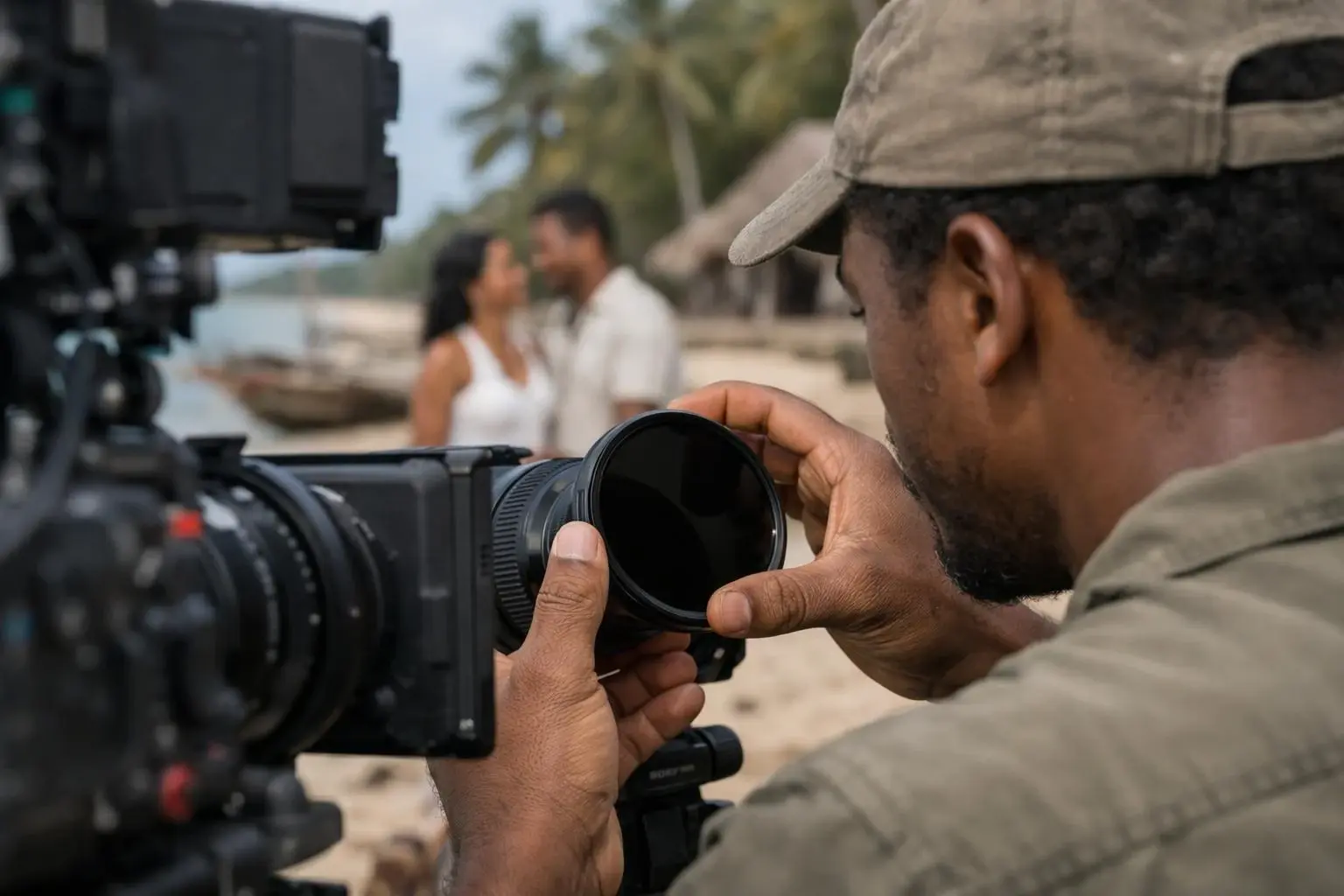
ND filters are essential tools for achieving professional-quality images in challenging lighting conditions. They provide filmmakers with the flexibility to control exposure independently of aperture, shutter speed. Or ISO, which is critical for maintaining visual consistency across shots. For example, a scene shot in bright daylight may require a wide aperture to achieve a shallow depth of field. But without an ND filter, the camera would overexpose the image. By using an ND filter, the filmmaker can keep the aperture wide open while reducing the light to a manageable level, ensuring the image remains properly exposed and visually cohesive with the rest of the project.
Beyond exposure control, ND filters enable creative effects that would otherwise be impossible. Slow-motion shots, for instance, require a slower shutter speed to capture smooth motion blur. But in bright light, this can lead to overexposure. An ND filter allows the camera to use a slower shutter speed without compromising exposure, making it possible to achieve cinematic slow-motion sequences even in broad daylight. Similarly, ND filters are used in time-lapse photography to extend exposure times, creating silky-smooth water or cloud movement in bright conditions.
ND filters become particularly important in situations where lighting conditions are beyond the camera’s native dynamic range or when creative control over exposure is critical. Outdoor shoots in bright sunlight are the most common scenario, as the intense light can easily overwhelm the camera’s sensor, forcing the filmmaker to compromise on aperture or shutter speed. For example, shooting a daytime scene with a shallow depth of field requires a wide aperture. But without an ND filter, the camera would overexpose the image, leading to loss of detail in highlights and an unbalanced look.
ND filters are also crucial for maintaining visual continuity in projects shot under varying lighting conditions. A scene filmed across multiple locations or times of day may require consistent exposure settings to ensure the footage cuts together smoothly. By using ND filters, filmmakers can adjust the light entering the lens without changing the camera’s internal settings, preserving the desired look throughout the shoot. And ND filters are indispensable for slow-motion or time-lapse sequences, where the camera’s shutter speed must be slowed to capture the desired effect. But the ambient light would otherwise cause overexposure.
In Madagascar, where intense tropical sunlight and diverse landscapes are common, ND filters are especially valuable for film production. Whether shooting on the white-sand beaches of Nosy Be, the lush rainforests of Andasibe. Or the arid plains of the south, filmmakers must contend with bright, high-contrast lighting conditions. ND filters allow crews to adapt quickly to these environments, ensuring consistent exposure and creative control regardless of the location’s natural light levels.
Polarizing filters reduce glare and reflections by blocking specific light waves. While ND filters uniformly reduce light intensity without altering polarization.
UV filters block ultraviolet light to protect the lens and reduce haze. But they do not significantly reduce visible light like ND filters.
Variable ND filters offer convenience but can introduce color shifts or vignetting at extreme settings.
A filmmaker on a Madagascar beach at noon uses a 6-stop ND filter. They keep the lens at f/2.8 and shutter at 1/50 second. Without the filter, bright sun would force the lens to f/16. That would lose the blurry background and smooth motion blur.
Depth of field is the range of distance in a scene that appears acceptably sharp in a photograph or film frame. It determines how much of the foreground, subject.
ISO film speed is a number that shows how sensitive film is to light. Higher numbers mean the film can work in dim light. They may look grainier. Lower numbers need more light but give sharper pictures. The International Organization for Standardization (ISO) sets this number. It helps film crews pick the right settings.
A camera stabilizer cuts shakes and bumps while filming. It keeps video smooth. This helps when you walk, run. Or ride. The shots stay steady even in rough places.
Color grading is the process of adjusting and enhancing the color, contrast. And overall visual tone of film or video footage in post-production. Color grading refines raw footage to achieve a consistent look, evoke emotions.
Cinematographer is the creative and technical professional responsible for capturing a film’s visual style through camera work, lighting. And shot composition. Cinematographers collaborate with directors to translate scripts into compelling images, ensuring each frame supports the story’s mood, tone. And narrative. Their decisions influence color, movement, depth.
PRO FIXERS MADAGASCAR
Contact PRO FIXERS MADAGASCAR for practical guidance on ND filter and related film production madagascar work in Madagascar.